
Common Meta Ads Mistakes to Avoid: The Ultimate 2026 Checklist for Growth
Why are you still paying for "brand awareness" whilst your bottom line remains stagnant? If you are frustrated by high spend and "vanity metrics" that don't convert, you aren't alone. Most advertisers are currently burning budget because they are clinging to outdated tactics. With the UK now imposing a 2% Digital Service Tax on ad delivery as of July 2026, and the average CPC sitting at $1.72, there is zero room for error. Understanding the common meta ads mistakes to avoid is no longer optional; it is a requirement for survival.
You probably feel that the platform has become a black box of confusing technical updates and inconsistent lead quality. I agree. The industry is full of bloated agencies passing your account to juniors who miss critical shifts like the March 3 attribution change or the May 19 Advantage+ API deprecation. This article promises to cut through the fluff and provide a clear framework for predictable sales growth. I will preview the essential 2026 checklist, covering everything from the phase-out of Lookalike audiences to the new Engage-through attribution model, so you can scale without breaking your funnel.
Key Takeaways
- Stop wasting 40% of your reach on the "Boost Post" trap and align your campaign objectives with revenue rather than vanity metrics.
- Secure your tracking by fixing broken Conversion API (CAPI) setups to ensure your data actually moves the needle for your bottom line.
- Learn why high-production aesthetics often kill conversions and how to use marketing psychology to stop the scroll in under 1.5 seconds.
- Identify the common meta ads mistakes to avoid when using Advantage+ tools to prevent over-targeting from strangling machine learning.
- Adopt a senior-led approach to scaling that provides direct, click-to-sale accountability without the fluff of bloated agency retainers.
Strategic Foundations: Blunders That Bleed Budget Whilst Scaling
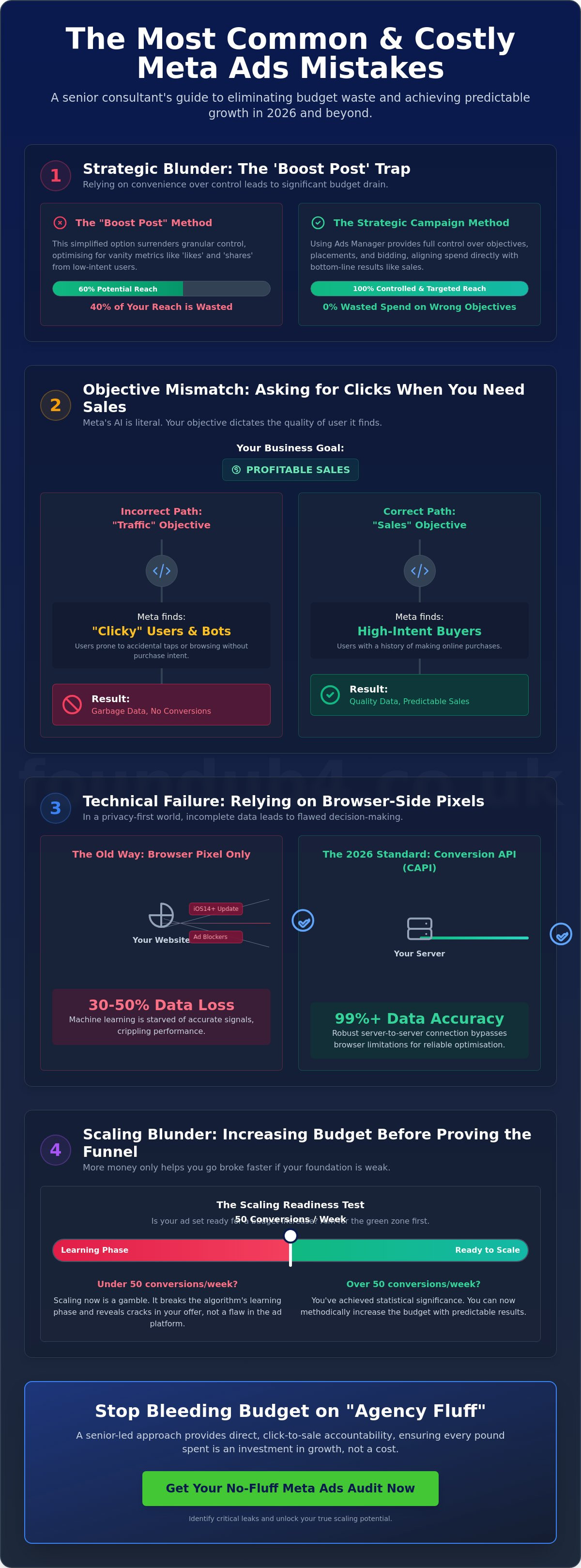
The "Boost Post" button is a trap. It is the most expensive convenience in the online advertising ecosystem. By choosing it, you surrender granular control over placements and bidding strategies, which typically leads to 40% wasted reach on low-intent users. This is one of the most common meta ads mistakes to avoid if you value your capital. Most business owners fail because they ignore their Business Model Canvas (BMC) when building campaign architecture. They treat Meta as a standalone silo instead of an integrated growth engine. If your campaign isn't built on the foundations of your value proposition and cost structures, you are just gambling. You need a North Star metric that goes beyond simple ROAS; focus on Lead-to-Close ratios or Customer Acquisition Cost (CAC) relative to Lifetime Value (LTV).
The Objective Mismatch
Stop choosing "Traffic" if you want sales. Meta's AI is a literal machine. If you ask for clicks, it will find the "clickiest" users. These are often accidental tappers or bots that never convert. This destroys your pixel quality by feeding the algorithm garbage data. You need "Click-to-Sale" accountability from day one. Meta optimises for the cheapest action available within your chosen objective. If that objective is "Awareness," you are buying cheap impressions that nobody remembers. It is a vanity metric graveyard. Always align your objective with the bottom-line result you actually need to pay your staff. No fluff. Just results.
Scaling Too Fast Without a Proven Funnel
Scaling is not a volume knob; it is an efficiency test. Doubling your budget before achieving statistical significance is a guaranteed way to break your algorithm's learning phase. I see brands achieve a 20% performance bump and immediately try to 10x their daily spend. This doesn't work. Aggressive scaling without a proven funnel is amongst the most common meta ads mistakes to avoid when trying to move the needle. It usually reveals cracks in your offer or landing page rather than a fault in the algorithm. You must establish a predictable baseline first. Aim for at least 50 conversions per ad set per week. If you can't hit that at a lower spend, more money will only help you go broke faster. Smart growth requires patience and data, not just a bigger credit limit.
Technical & Tracking Failures: Why Your Data Isn’t Moving the Needle
Bad data is worse than no data. It misleads you into scaling losing campaigns whilst cutting your actual winners. If your Conversion API (CAPI) is misconfigured, you are essentially flying blind. This remains one of the most common meta ads mistakes to avoid in 2026. You cannot rely on a browser-side pixel to guide your strategy. It is a technical suicide mission that leaves your budget vulnerable to signal loss and prevents your account from ever reaching statistical significance.
The "Set and Forget" fallacy is equally dangerous. Whilst Meta’s AI is sophisticated, it lacks business context. It doesn't know your margins, your stock levels, or your long-term business goals. Without senior-led oversight, Advantage+ campaigns often drift toward high-volume, low-value interactions. This is particularly true following the March 3, 2026 attribution update, which now only counts link clicks for click-through conversions. If you aren't monitoring these shifts with a clinical eye, your reported ROAS is likely a work of fiction. No fluff. Just data.
Are you paying twice for the same customer? Failing to exclude past purchasers from acquisition campaigns is a basic blunder that I see far too often. It inflates your frequency and drains your budget on people who have already converted. Keep your funnel clean and your spend focused on new growth. If you are unsure if your tracking is actually working, a custom-built Meta Ads audit can quickly highlight these technical leaks and stop the bleed.
The Post-iOS14 Tracking Reality
The browser pixel is a ghost of marketing past. In 2026, privacy regulations and aggressive ad blockers can strip away 30% to 50% of your conversion data before it ever reaches Meta. Reclaiming this lost ground requires robust server-side tracking. The Conversion API (CAPI) is the essential bridge between your website and Meta’s algorithm. It bypasses browser limitations to ensure your data is accurate and actionable. Without it, the machine learning models that power your growth are starved of the signals they need to find your next customer. This is a non-negotiable for anyone serious about common meta ads mistakes to avoid.
Audience Overlap and Cannibalisation
Internal bidding wars are a silent budget killer. When you run multiple ad sets targeting the same audience segments, you are effectively bidding against yourself. This behaviour drives up your own CPMs and fragments your data, making it impossible for the algorithm to optimise effectively. Organise your account structure to ensure each ad set has a distinct purpose and a unique audience. Use robust exclusion lists to prevent your retargeting audiences from seeing your top-of-funnel ads. This keeps your funnel efficient and ensures every pound spent is working to find a fresh lead or close a warm prospect.
Creative & Copy Mistakes: Beyond Aesthetics to Marketing Psychology
Aesthetics do not pay the bills. One of the most common meta ads mistakes to avoid is falling for "Pretty Ad" syndrome. You spend thousands on high-production video only to see your ROAS tank. Why? Because polished studio content often screams "advertisement," triggering immediate ad blindness in a savvy UK audience. Data from 2026 shows that AI-powered creative tools actually drive an 18% higher click-through rate compared to traditional human-designed assets. The goal isn't to look expensive; it's to look relevant. If your creative doesn't stop the scroll in the first 1.5 seconds, the rest of your funnel is irrelevant.
Stop selling features. Your customers don't care about your technical specifications; they care about their own transformation. If your copy focuses on "what it is" instead of "who they become," you are bleeding money. This psychological misalignment is why many high-CTR ads fail to move the needle. You need to sell the "New Self." No fluff. No vanity metrics. Just a direct line to the buyer's intent.
The Psychology of the Scroll
To stop a user mid-scroll, you must trigger a visceral reaction. This requires using consumer psychology to identify a specific pain-point hook immediately. Your creative should act as a mirror, reflecting the buyer’s current frustration and their desired future state. In the UK market, testing raw User-Generated Content (UGC) against highly produced versions is essential. Often, the less "perfect" version feels more authentic and builds trust faster. This isn't about being cheap; it's about being effective. Smart execution beats a big production budget every time.
The Landing Page Disconnect
This is where most campaigns die. You can have the best ad in the world, but if your landing page feels like a different brand, the user will bounce. Maintaining a "linguistic scent" from the ad copy to the checkout is critical. If your ad promises a specific solution, that solution must be the first thing they see on the page. A slow-loading mobile page is a silent ROAS killer. If your page takes longer than 2.5 seconds to load, you've lost half your traffic before they even see your offer. Conversion Rate Optimisation (CRO) is the silent partner of Meta Ads. Without it, you are just pouring water into a leaky bucket. Click-to-sale accountability starts with the ad but ends on the page.
Audience Targeting & Scaling: The Advantage+ Pitfalls
Over-targeting is a relic of 2018. If you are still layering five different interest groups to find a "niche" audience, you are strangling Meta’s machine learning. One of the most common meta ads mistakes to avoid is the belief that you are smarter than the algorithm’s billions of data points. By narrowing your reach, you drive up your CPMs and prevent the AI from finding the most profitable conversion paths. In 2026, 78% of advertisers have migrated to Advantage+ campaigns, but many are doing so blindly. Whilst Advantage+ Shopping campaigns can offer a 32% lower CPA, they often hide inefficiencies by over-crediting retargeting wins as new acquisitions. You must know when to trust the AI and when to pull the plug. No fluff. Just hard data.
Failing to separate your testing sandbox from your scaling campaigns is another budget killer. You shouldn't test new creative in your "winning" ad sets. This creates volatility and resets the learning phase. Instead, organise your account with a dedicated testing environment to find high-performing assets before moving them into your scaling campaign. If you want a strategy built on data rather than algorithm-worship, my Meta Ads Management service provides the senior-led oversight you need to scale without the waste.
Broad vs. Interest-Based Targeting
Broad targeting is the senior-led choice for 2026 scaling. In this model, your creative does the heavy lifting. The algorithm reads your ad’s visual and linguistic cues to identify who is most likely to convert. This is why the "Pretty Ad" syndrome mentioned in previous sections is so dangerous; if your ad is vague, your targeting will be too. It is also important to note that Lookalike audiences are being fully phased out in 2026. They are being replaced by predictive models based on aggregated behaviour. Stop clinging to old targeting methods and start focusing on feeding the machine better creative inputs. This is how you move the needle.
Managing Ad Fatigue and Decay
Your "winning" creative has an expiration date. Identifying the signs of frequency bloat is critical before your ROI tanks. If your frequency on a cold audience hits 3.5 whilst your CTR drops, your creative is dead. You need a structured creative refresh cycle. This doesn't mean you need a new video every week. It means you should use dynamic creative testing to iterate on your hooks and headlines. Test fast. Find what works. Cut the rest. Smart execution requires constant vigilance, not a "set and forget" mindset.
The Senior Consultant’s Audit: Eliminating Agency Fluff
Most marketing agencies are lead-gen factories. They sell you on the senior partner's 20 years of experience but hand your budget to a junior who started three months ago. This structural misalignment is one of the most common meta ads mistakes to avoid if you value your capital. Juniors follow checklists. They don't understand the nuance of your unit economics or how to pivot when the UK’s 2% Digital Service Tax eats into your margins. You aren't paying for a "checklist follower." You are paying for a master craftsman who knows how to move the needle. No fluff. No juniors. Just results.
Bloated retainers fund fancy office coffee machines and "account managers" who exist only to send you monthly reports full of vanity metrics. If your agency is bragging about impressions whilst your sales are down, you have a fundamental problem. My "Anti-Agency" approach is built on a different philosophy: direct click-to-sale accountability. I strip away the corporate-speak and focus entirely on the bottom line. Built to convert. Built to scale. Built by me. This transparency ensures that every pound of your ad spend is targeted toward booked clients, not just passive engagement.
Senior-Led Execution vs. Junior Bloat
Your account needs a master craftsman, not an intern. When you work with FoundUB4, you get direct access to over two decades of industry experience. I don't hide behind polished reports or hollow promises of "brand awareness." I focus on predictable ROI. By cutting the agency waste, we ensure your strategy is agile enough to handle 2026's technical shifts, such as the May 19 Advantage+ API deadline. We eliminate the fluff and focus on smart execution that actually impacts your bank balance. This is "Not an Agency Posing as One." This is a senior partnership.
Booking Your Meta Ads Audit
Is your current agency coasting on your budget? If they haven't addressed the 2026 attribution changes or the phase-out of lookalike audiences, the answer is likely yes. You need to audit your account for these common meta ads mistakes to avoid before you burn another month of budget. My methodology is clinical: test fast, find what works, and scale hard. If you are tired of being passed off to junior staff and want a partner who prioritises your growth over their own retainer, it is time for a change. Book a direct growth strategy call with FoundUB4 today to stop the bleed and start driving predictable revenue.
Take Control of Your 2026 Meta Ads Strategy
You now have the framework to stop the bleed and reclaim your budget. By fixing your CAPI tracking and ditching the "Boost Post" trap, you are already ahead of the majority of your competitors. Remember that your creative is your primary targeting tool in this automated landscape. Don't let a slow landing page or a junior account manager destroy your ROI. Eliminating these common meta ads mistakes to avoid is the only way to ensure your budget actually moves the needle for your bottom line. No fluff. Just hard execution.
Stop settling for vanity metrics and hollow agency reports. You deserve direct, senior-led expertise that prioritises your profit over a bloated retainer. With over 20 years of industry experience, I provide a hands-on service that eliminates junior staff and focuses entirely on click-to-sale accountability. I build it. I manage it. You see the results. Stop wasting ad spend. Get a senior-led Meta Ads audit today. Your funnel is ready for predictable growth. Let's get to work.
Frequently Asked Questions
How much should I spend on Meta Ads before I see results?
You must spend enough to generate 50 conversion events per ad set every week to exit the learning phase. With the global average CPC sitting at $1.72 in 2026, a daily budget of £5 is no longer sufficient for most UK industries. If you aren't providing the algorithm with enough data to optimise, you are just gambling. Smart execution requires capital that matches your growth goals.
Is Facebook Ads still effective in the UK for 2026?
Meta remains the dominant force in UK digital advertising with a projected global revenue of $167 billion in 2026. Despite the new 2% UK location-based fee effective July 1, 2026, the platform’s 11.8 million active advertisers prove its efficacy. It’s not about whether the platform works; it’s about whether your strategy identifies the common meta ads mistakes to avoid that bleed budgets.
Why is my Meta Ads ROAS dropping after a week of good performance?
Your ROAS usually drops because of audience saturation or creative fatigue. If your frequency hits 3.5 on a cold audience, your "winning" ad is likely dying. The algorithm has already picked the "low-hanging fruit" within your segment. You need a structured creative refresh cycle to find new winners before your performance tanks. No fluff. Just constant iteration.
Should I use Advantage+ campaigns or manual targeting?
Use Advantage+ for scaling once you have proven creative, as these campaigns offer a 32% lower CPA on average. Manual targeting should be reserved for your "testing sandbox" where you isolate specific variables. In 2026, 78% of advertisers use Advantage+ because machine learning is more efficient at finding buyers than human interest-layering. Trust the AI for volume, but keep senior-led oversight for strategy.
What is the most common mistake for small businesses on Meta?
The most common meta ads mistakes to avoid for small businesses is the "Boost Post" trap, which leads to 40% wasted reach on low-intent users. Many small firms also ignore the 2026 data declaration policies, leading to account suspensions. They focus on "likes" rather than click-to-sale accountability. If you don't have a Conversion API (CAPI) setup, you are losing 30% of your data signals.
How do I fix a "High CPM" on my Meta ad sets?
High CPMs are usually a signal of poor creative quality or overly narrow targeting. If your ad doesn't stop the scroll in 1.5 seconds, Meta penalises you with higher costs. Broadening your audience and using AI-generated creative, which sees an 18% higher CTR, can lower your costs. Stop strangling the algorithm with niche interests and let the creative do the targeting.
What is the difference between a Meta Ads agency and a senior consultant?
An agency often passes your account to a junior who follows a generic checklist. A senior consultant provides direct, master-craftsman execution with no bloated retainers. You get 20 years of experience and a "Built by Me" philosophy. It is the difference between a lead-gen factory and a partnership focused on moving the needle for your bottom line.
Can I run Meta Ads without a landing page?
You can run lead-form ads, but they often result in inconsistent lead quality. A custom-built, CRO-optimised landing page is essential for predictable sales growth. Without a landing page, you lose the ability to maintain the "linguistic scent" from ad to checkout. High-intent buyers expect a professional destination before they part with their money.
