
Facebook Ads for Ecommerce UK: The No-Nonsense Guide to Scaling in 2026
Your agency's "brand awareness" metrics are likely masking the reality of a market where Meta’s £2.99 ad-free subscription is actively shrinking your reachable audience. It’s a bitter pill to swallow when you’re already battling a £13.91 average CPA and a 2% Digital Services Tax passed directly onto your billing statement. You’re right to be skeptical of the polished reports landing in your inbox. Most UK ecommerce brands are currently burning cash on cold audiences that don’t convert, all whilst being told to "trust the process" by a junior who has never owned a P&L.
I’m going to show you how to cut through the fluff and build a high-converting engine for facebook ads for ecommerce uk that delivers predictable sales. You’ll learn how to navigate the January 2026 HFSS advertising ban and leverage AI-powered Advantage+ Shopping to reclaim your ROAS. This isn't about vanity metrics; it's about senior-led strategy and click-to-sale accountability that finally moves the needle for your brand.
Key Takeaways
- Stop burning cash on vanity metrics and refocus your spend on predictable sales that actually cover your UK corporation tax.
- Build a high-converting engine for facebook ads for ecommerce uk by prioritising the Conversions API (CAPI) to maintain 100% data accuracy amongst privacy shifts.
- Learn to identify "ad fatigue" and use hook-rate analysis to ensure your creative strategy is actually stopping the scroll in a competitive market.
- Audit your tracking infrastructure to verify that your Meta Pixel and Shopify store are communicating effectively without data loss.
- Transition from bloated agency retainers to a senior-led growth framework that provides direct, click-to-sale accountability.
Why Most UK Ecommerce Brands Waste 40% of Their Facebook Ad Spend
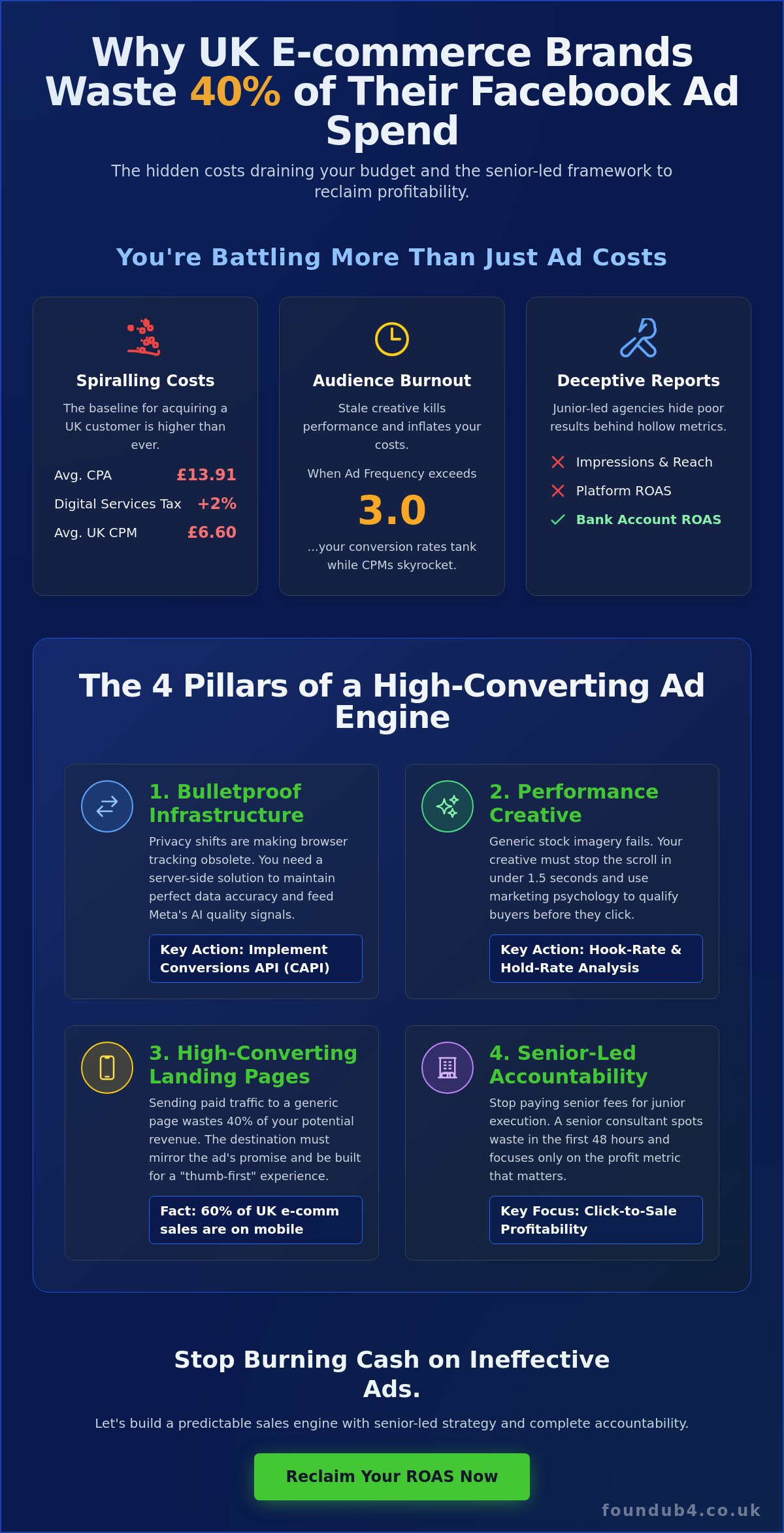
The UK ecommerce market is a £137 billion arena where inefficiency is punished by the bottom line. Most brands are haemorrhaging cash because they've been sold a dream of "brand awareness" that doesn't pay the bills. With the UK Digital Services Tax adding a 2% surcharge on top of an average £13.91 CPA, there is zero room for error. If you aren't tracking every penny with clinical precision, you aren't scaling; you're just subsidising Meta's data centres. Click-to-Sale Accountability is the only metric that moves the needle because it demands a direct, documented link between every ad penny spent and a confirmed order in your bank account.
Ad fatigue in the UK is brutal. When your frequency creeps above 3.0 on a cold audience, your CPMs, currently averaging £6.60 across the UK, will skyrocket whilst your conversion rates tank. Most agencies ignore this. They prefer the safety of bloated retainers that incentivise them to keep spending your budget even when the creative has died. They win on the management fee; you lose on the ROAS. They hide behind "impressions" and "reach" because these metrics are easy to inflate, but they won't help you pay your UK corporation tax or reach that £90,000 VAT threshold.
The Problem with "Spray and Pray" Targeting
Broad targeting is the standard for facebook ads for ecommerce uk in 2026, but it's a double-edged sword. Meta's AI is powerful, but it's only as good as the data you feed it. If your tracking infrastructure is "dirty" or your pixel is misfiring, the algorithm will find the cheapest clicks, not the most profitable customers. You need a sophisticated creative strategy that uses marketing psychology to qualify the buyer before they even click. Ignoring the "why" behind the buy is the fastest way to increase waste. Without a clear hook, you're just paying for "window shoppers" who bounce after three seconds on your site.
Vanity Metrics vs. Predictable Sales
Platform ROAS is a fairy tale. It doesn't account for VAT, shipping costs, or the 2% tax Meta passes on to you. You need to focus on "Bank Account ROAS". A high CTR is a vanity metric if your landing page isn't built to convert. Within the wider world of online advertising, the difference between success and failure is often found in the details that juniors miss.
- No juniors managing your account whilst you pay senior fees.
- No hollow reports filled with "reach" and "impressions".
- Just senior-led execution that spots waste in the first 48 hours.
The 4 Pillars of a High-Converting UK Ecommerce Ad Engine
Scaling facebook ads for ecommerce uk requires more than just a "good eye" for design. It demands a rigid four-pillar structure that balances technical precision with psychological triggers. First, your infrastructure must be bulletproof. With Meta’s £2.99 ad-free subscription reducing reachable audiences, every data point counts. You must implement the Conversions API (CAPI) to bypass browser-side tracking losses. This ensures 100% data accuracy amongst tightening privacy rules, allowing the algorithm to find your next £13.91 CPA customer with surgical accuracy.
Creative that Moves the Needle
Forget "pretty" ads. In 2026, performance creative is the only thing that wins. UK consumers are savvy; they spot stock imagery and generic templates a mile away. You need "Master Craftsman" creative that acknowledges specific UK advertising regulations, especially if you're navigating the January 2026 HFSS ban. Use dynamic creative testing to let the market decide what works. Your favourite ad is irrelevant. Only the "Bank Account ROAS" matters. If your creative doesn't stop the scroll in under 1.5 seconds, you're just donating money to Mark Zuckerberg.
Landing Pages: The Unsung Hero of Meta Ads
Sending traffic to a generic collection page is the quickest way to kill your margins. 60% of UK ecommerce transactions now happen on mobile. If your landing page isn't optimised for a "thumb-first" experience, you're losing 40% of your potential revenue before the page even loads. A high-converting page must mirror the ad's promise with clinical precision. At FoundUB4, I don't just "run ads"; I build the destination. High-converting landing page creation is baked into the strategy, not treated as an afterthought.
The "test fast" mantra is often an excuse for a lack of strategy. You need to "scale smart". This means moving beyond vanity metrics and focusing on incremental growth. With the UK's social commerce market reaching £11.75 billion in 2026, the opportunity is massive for brands that move with intent. Stop chasing impressions. Start building a senior-led engine for facebook ads for ecommerce uk that delivers predictable, scalable sales. No juniors. No fluff. Just execution that works.
Senior Consultant vs. Bloated Agency: Making the Right Choice
Most UK ecommerce brands are tired of the agency bait-and-switch. You meet the charismatic founder during the pitch, only to have your account handed to a junior graduate three days later. You're paying senior fees for someone who is still learning what a "Good" hook rate looks like. In a market valued at £137 billion, this lack of expertise is a luxury you can't afford. The "Anti-Agency" approach is a deliberate shift toward quality over quantity, ensuring every campaign is built by a master craftsman rather than an assembly line. When you invest in facebook ads for ecommerce uk, you aren't just buying traffic; you're buying the experience required to navigate a £13.91 average CPA without flinching.
Why "Senior-Led" Actually Matters for Your ROI
Navigating Meta’s 2026 algorithm requires more than just following a checklist. With 20 years of industry experience, I've seen every platform shift from the birth of the pixel to the rise of Advantage+ Shopping. A senior-led strategy means your ads are managed by the person who actually builds them. There is no "Account Manager" layer to dilute the strategy or slow down communication. This direct partnership allows for faster pivots. If a creative isn't moving the needle on a Tuesday morning, it's killed by Tuesday afternoon. We don't wait for a monthly "sync" to stop the bleeding. We focus on smart execution that protects your margins whilst your competitors are busy "testing" their way into debt.
The Cost of "Agency Bloat"
Traditional agencies hide their lack of results behind jargon-heavy reports and vanity metrics like "impressions" and "reach." These metrics won't help you reach the £90,000 VAT registration threshold or manage the 2% Digital Services Tax. As highlighted in the UK Parliament briefing on online advertising, the economic impact of digital spend is massive, but so is the potential for waste in a poorly regulated internal agency structure. My "No Bloated Retainers" policy ensures you're paying for performance, not for an agency's central London office rent or a fleet of account managers.
- No juniors "learning" on your budget.
- No hidden layers of management.
- No hollow reports that ignore the bottom line.
How to Audit Your Current Facebook Ads Performance
Most audits performed by agencies are nothing more than a sales pitch in disguise. They'll tell you your "reach" is up whilst your bank balance is down. To truly scale facebook ads for ecommerce uk, you need a clinical assessment of your funnel. Stop looking at the aggregate data and start looking at the friction points. If your £0.43 average CPC isn't turning into a profitable sale, the problem isn't the platform; it's your execution. A real audit identifies exactly where your money is leaking before you commit another penny to the algorithm.
- Step 1: Tracking Integrity. Verify that your Meta Pixel and Conversions API (CAPI) are actually communicating with your store. If your "Event Match Quality" is low, you're feeding the AI dirty data.
- Step 2: Creative Hook Analysis. Calculate your "Hook Rate" by dividing 3-second video views by impressions. If it's below 25%, your creative is failing to stop the scroll in a competitive UK market.
- Step 3: Attribution Reality Check. Don't rely on the Meta dashboard alone. Use a "last-click" or MER (Marketing Efficiency Ratio) approach to see where the revenue is actually landing.
- Step 4: Destination Audit. Check your landing page conversion rate. If your ad has a high CTR but your page converts at less than 2%, you have a destination problem, not a traffic problem.
Identifying the Bottleneck in Your Funnel
You need to know if you have a traffic problem, a conversion problem, or a product-market fit problem. A traffic problem is solved in the Ads Manager; a conversion problem is solved with Landing Page Creation. If people are clicking but not buying, your messaging likely lacks the psychological triggers needed to move a UK consumer from "curious" to "customer". I use a "Click-to-Sale" methodology to find these hidden profit leaks. We look at the "Hold Rate" to see if your video content actually keeps attention or if your audience is bouncing before the offer is even made.
Metrics That Actually Matter in 2026
ROAS is a deceptive metric because it doesn't account for the 2% Digital Services Tax or your shipping overheads. Your new North Star should be MER. This is your total revenue divided by your total ad spend. It gives you the "big picture" of how facebook ads for ecommerce uk are impacting your entire business. You must also calculate your "Break-even CAC" (Customer Acquisition Cost). If you don't know the exact pound amount you can spend to acquire a customer whilst remaining profitable, you cannot scale. Agencies love impressions because they are easy to get. I focus on profit because it’s the only thing that pays your UK corporation tax.
If you're tired of vanity reports and want a clear path to scale, request a senior-led performance audit to find your hidden profit.
Scaling to 7-Figures with FoundUB4: The Growth Framework
Scaling isn't about turning a dial or blindly doubling your budget. It's about precision. Most agencies scale by increasing your spend and hoping the algorithm saves them. I scale by tightening the screws on your funnel and protecting your margins. Scaling facebook ads for ecommerce uk from five to seven figures requires a framework that doesn't break under the weight of a £13.91 average CPA. It requires the "Built by Me" guarantee. Every campaign, every line of copy, and every tracking event is senior-led and custom-built for your specific business goals. No juniors. No fluff. No vanity metrics. Just predictable, measurable results that show up in your bank account.
Custom-Built Growth Strategies
A "one-size-fits-all" template is the enemy of ecommerce growth. If your consultant is using the same strategy for a high-end fashion brand as they are for a supplements store, they're wasting your money. Your growth engine must be bespoke. I integrate high-performance Meta Ads with strategic Social Media Consultancy to ensure your brand presence is holistic and authoritative. We don't just "run ads"; we organise your entire growth engine. This means aligning your Landing Page Creation with your ad creative to ensure a seamless "thumb-to-checkout" experience. This is the "Anti-Agency" approach. It is a deliberate focus on quality over quantity. I only work with a handful of brands at any one time to ensure direct accountability and senior-level expertise. Built to convert. Built to scale. Built by me.
Your Next Steps to Profitable Scaling
The UK ecommerce market is projected to grow at a compound annual growth rate (CAGR) of 9.72% between 2026 and 2031. You can either capture that growth with a senior expert or continue burning 40% of your spend on "awareness" that never converts. Now is the time to cut the waste. Stop paying for bloated agency retainers that fund fancy offices and junior salaries. Focus on high-impact marketing that moves the needle for your bottom line. You need a partner who understands that profit is the only metric that matters. You get direct access to 20 years of industry experience and a battle-hardened perspective on facebook ads for ecommerce uk. We find the hidden profit in your data and scale it aggressively.
The path to 7-figures is built on smart execution and click-to-sale accountability. If you're ready to stop the bleeding and start scaling with a master craftsman, let's talk. No sales pitch. Just a direct conversation about your growth.
Ready to move the needle? Book your Growth Strategy call here
Reclaim Your Margins and Scale with Precision
The UK ecommerce landscape in 2026 doesn't forgive mediocrity. With a £137 billion market at stake, relying on "brand awareness" and vanity metrics is a fast track to wasted spend. You've seen how a clinical audit of your hook rates and a bulletproof CAPI setup can transform your results. Scaling facebook ads for ecommerce uk is no longer about manual targeting; it's about performance creative and a destination that converts.
You don't need a bloated agency with layers of account managers and junior staff learning on your budget. You need click-to-sale accountability and a senior expert like Barrie Le Gall who actually moves the needle. My master craftsman approach is built on 20 years of battle-hardened experience. I build the strategy. I manage the ads. I create the landing pages. No fluff. No juniors. Just predictable sales whilst protecting your bottom line.
Stop wasting ad spend. Get a senior-led Meta Ads strategy that actually scales.
Your brand deserves a growth engine that works as hard as you do. Let's build it.
Frequently Asked Questions
Is Facebook advertising still effective for UK ecommerce in 2026?
Facebook remains the dominant force in a £137 billion UK ecommerce market. Whilst Meta’s £2.99 ad-free subscription has reduced total audience reach, the platform's AI still drives the highest volume of predictable sales. Success in 2026 depends on high-quality video creative and robust tracking. You must use original Reels and CAPI to ensure you aren't losing 30% of your data to privacy regulations.
How much should a UK ecommerce brand spend on Facebook ads initially?
You should budget for at least 50 conversions per week per set to exit the "learning phase." With an average UK CPA of £13.91, this suggests a starting budget of approximately £700 per week. Spending less than this often results in stalled campaigns that never gather enough data for the AI to optimise properly. It's better to spend more on one winning creative than to spread a thin budget across ten average ones.
Can I manage my own Facebook ads or do I need an agency?
You can manage them yourself, but 40% of self-managed accounts waste spend on technical errors and poor creative. Managing facebook ads for ecommerce uk is a full-time specialism requiring deep knowledge of CRO and CAPI. Without a senior expert, you're essentially paying for your own education through wasted ad spend. Most business owners are better off focusing on fulfilment whilst a consultant handles the scaling.
What is the difference between a Meta Ads agency and a Senior Consultant?
Agencies typically pass your account to a junior whilst you pay senior fees. A Senior Consultant provides a "Built by Me" guarantee with direct click-to-sale accountability. You cut out the account manager layer, which reduces communication friction and allows for faster pivots. FoundUB4 operates as an "Anti-Agency" because it prioritises smart execution over bloated retainers and junior-led management.
How long does it take to see results from a new ecommerce ad campaign?
You will see data immediately, but the algorithm requires 7 days to exit the learning phase. During this first week, performance can fluctuate as Meta's AI identifies who is most likely to convert. Don't touch the ads during this period. By day 14, you should have enough statistically significant data to identify winners and kill the creative that isn't moving the needle.
What metrics should I be tracking to ensure my Facebook ads are profitable?
Track your Marketing Efficiency Ratio (MER) and Bank Account ROAS. MER is your total revenue divided by your total ad spend; it's the only way to see how facebook ads for ecommerce uk impact your bottom line. Platform ROAS is often inflated and doesn't account for the 2% Digital Services Tax or VAT. You need to know your "Break-even CAC" to ensure every scaled pound is actually profitable.
How much does Facebook ads management cost in the UK?
Management costs vary widely across the UK market depending on the level of expertise provided. Beware of "cheap" agencies that charge low fees but hire juniors who waste thousands of pounds in ad spend. A performance-led partnership should be viewed as an investment in ROI, not a flat cost. The most transparent models avoid bloated retainers and focus on value-driven growth.
What happens if my Facebook ad account gets disabled?
You must follow the formal appeal process through the Meta Business Suite, but prevention is your best strategy. Ensure your ads comply with the January 2026 HFSS regulations and the ASA's AI-powered monitoring systems. Most accounts are disabled due to "dirty" data or non-compliant creative. If you are disabled, a senior consultant can often help you identify the specific policy breach that triggered the ban.
