
How to Scale a Business with Paid Social: The Senior Consultant’s Guide for 2026
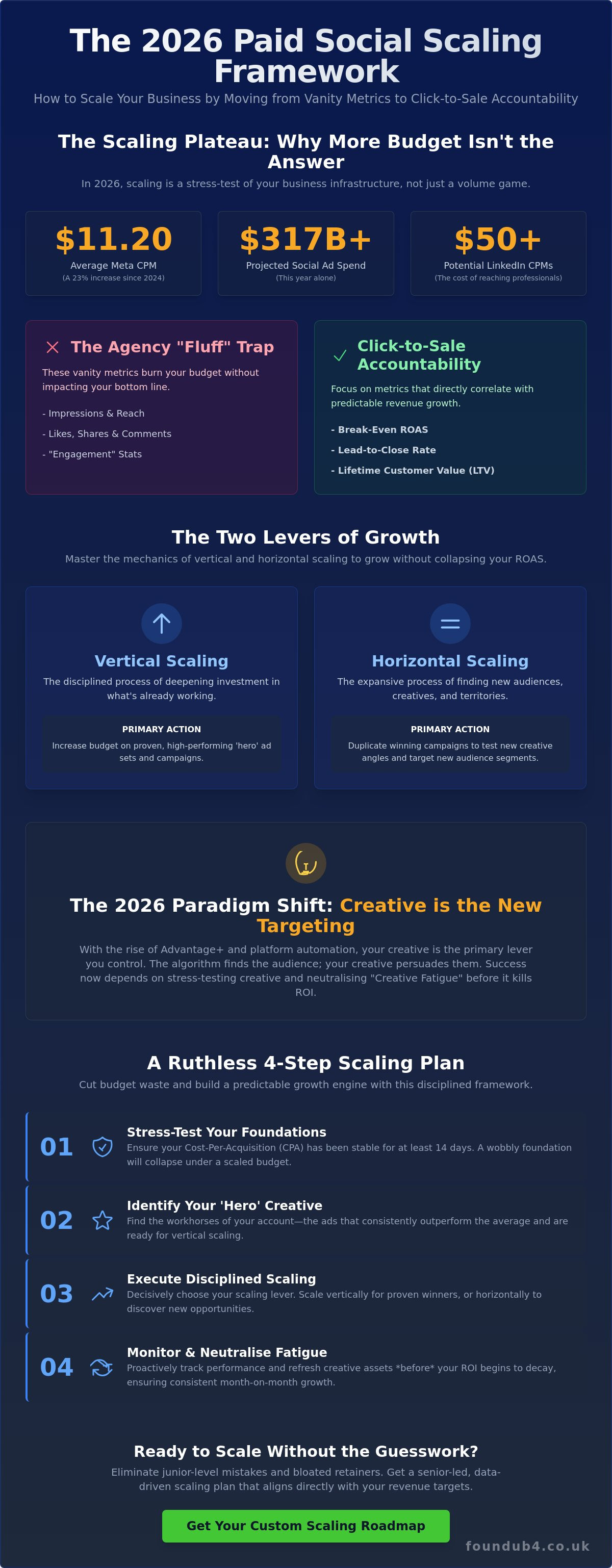
Increasing your ad budget is the fastest way to set fire to your profit margins if you haven't earned the right to spend. Most brands treat scaling as a volume game, but in 2026, it's actually a stress-test of your business infrastructure. If you're looking for how to scale a business with paid social, you have to stop chasing impressions and start demanding click-to-sale accountability. You’ve likely felt the sting of plateaued growth whilst Meta CPMs have climbed to an average of $11.20. With social ad spending projected to exceed $317 billion this year, it's exhausting to watch your budget vanish on poor-quality leads while an agency hides behind "engagement" stats that don't pay the bills.
I'm sharing the exact framework I use to build predictable revenue growth without the bloated retainers or junior-level guesswork. You'll learn how to stop wasting money on vanity metrics and start using a clear scaling roadmap that aligns your ads directly with your sales targets. We’ll examine the 2026 shift toward Advantage+ automation, the reality of $50 LinkedIn CPMs, and how to stress-test your creative and landing pages to ensure every pound spent actually moves the needle.
Key Takeaways
- Master the mechanics of vertical and horizontal growth to increase your ad spend whilst maintaining a stable cost-per-acquisition.
- Discover the exact framework for how to scale a business with paid social by using creative as your primary targeting lever in 2026.
- Identify and neutralise "Creative Fatigue" before it kills your ROI, ensuring consistent month-on-month revenue growth.
- Execute a ruthless four-step scaling plan that cuts budget waste and stress-tests your landing pages before you add fuel to the fire.
- Eliminate agency fluff and junior-level guesswork by prioritising senior-led execution and direct click-to-sale accountability.
The Scaling Plateau: Why Your Paid Social Has Stopped Moving the Needle
Scaling isn't just about throwing more money at a screen. It is the disciplined process of increasing ad spend whilst maintaining or improving your cost-per-acquisition (CPA). Most brands fail because they fall into the "more money, more problems" trap. They double their budget and watch their ROAS collapse overnight. This happens because their infrastructure wasn't built to handle the pressure. If you want to know how to scale a business with paid social, you must first accept that what worked at a £5,000 monthly spend will almost certainly break at £50,000. Performance plateaus occur when your creative reaches its limit or your audience pool becomes exhausted. You aren't just buying more traffic; you're buying more expensive, harder-to-convert traffic.
The evolution of social network advertising has moved us past the era of simple interest targeting. In 2026, the platforms are more automated than ever. Meta CPMs have risen to an average of $11.20, an increase of roughly 23% since 2024. This means your margin for error has vanished. Real business growth is measured in revenue and booked clients, not the "vanity growth" of impressions and reach that agencies love to report. You need to identify if your account is actually ready for fuel. If your conversion rate is inconsistent or your lead quality is poor, scaling will only accelerate your losses.
The Myth of the Magic Algorithm
Stop treating the Meta algorithm like a black box that requires secret incantations. It's a machine learning tool that responds to data. If your business model is broken or your offer is weak, no amount of "tweaking settings" will save you. The shift in 2026 is away from technical hacks and toward strategic growth marketing. I don't care about your "power 5" or your manual bid caps if your creative doesn't resonate. Success comes from smart execution, not hidden buttons in the Ads Manager.
Vanity Metrics vs. Click-to-Sale Accountability
Likes, shares, and comments are ego-boosters. They don't pay your staff or fund your expansion. I focus on click-to-sale accountability. This means tracking the journey from the first impression to the final bank transfer. To master how to scale a business with paid social, you must set realistic scaling benchmarks based on your actual profit margins. If you don't know your break-even ROAS to the penny, you aren't ready to scale. We look at the metrics that actually move the needle: lead-to-close rates and lifetime customer value.
- Budget Waste: Are you spending 20% of your budget on retargeting people who already bought?
- Lead Quality: Are your ads attracting "window shoppers" or high-intent buyers?
- Consistency: Has your CPA remained stable for at least 14 consecutive days?
Vertical vs Horizontal Scaling: The Mechanics of Growth
Scaling is a mechanical test of your creative's ceiling. It isn't a guessing game. To understand how to scale a business with paid social, you must master the two primary levers: vertical and horizontal growth. Vertical scaling is the process of deepening investment in proven winners. If an ad set is delivering a stable CPA at £100 a day, you want to see if that performance holds at £1,000. Many traditional agencies religiously follow the "20% Rule," where they only increase budgets by a small margin every 48 hours to avoid "resetting the learning phase." In 2026, this approach is often too slow for aggressive growth. If your creative is strong and your tracking is precise, you can afford to be bolder.
Horizontal scaling is about breadth. You aren't just spending more on one audience; you're finding new ones. This involves testing new creative angles or moving into new territories. As of March 2026, Meta's Advantage+ Shopping Campaigns have become the default for eCommerce, making manual campaign structures increasingly obsolete. These AI-powered systems handle the heavy lifting of audience discovery, but they require high-quality data to function. If you're struggling to decide which lever to pull first, a social media consultancy session can help you identify the path of least resistance for your specific offer.
When to Scale Vertically
Vertical scaling works best when you have "hero" ads that consistently outperform the account average. These are the workhorses of your campaign. You don't need to fear the learning phase if your conversion volume is high enough. In 2026, the algorithm is smart enough to handle larger budget jumps if the initial data is robust. I look for ads that maintain their efficiency even as the frequency increases. If the CPA remains stable whilst the spend doubles, keep pushing until you hit the point of diminishing returns.
When to Scale Horizontally
Horizontal scaling is the answer when your primary audiences start to saturate. This is where you test new creative hooks to appeal to different customer segments. You might also expand beyond Meta. TikTok remains a powerhouse for engagement, with rates averaging 3.85% to 4.1%, whilst LinkedIn is the go-to for B2B, despite CPMs ranging between $30 and $50. Horizontal growth is about diversifying your risk. By spreading your budget across different platforms and creative angles, you protect your business from the volatility of a single algorithm. It's about building a resilient, multi-channel funnel that doesn't collapse if one platform changes its rules.
- Broad Targeting: Trusting the AI to find your buyers without restrictive interest filters.
- Creative Testing: Launching new "hooks" to capture segments you haven't reached yet.
- Platform Expansion: Moving successful Meta creative over to TikTok or LinkedIn to find fresh eyes.
Creative is the New Targeting: Scaling Beyond the Algorithm
Targeting is no longer your competitive advantage. In 2026, Meta’s Advantage+ and AI-driven systems handle the heavy lifting of audience discovery. Your creative is now the primary lever that dictates who sees your ad and what you pay for that attention. If you want to master how to scale a business with paid social, you must stop acting like a media buyer and start thinking like a performance architect. Creative is the only variable that can offset rising CPMs. When you spend more, you reach broader, colder audiences. Only high-impact creative can bridge the gap between a stranger and a customer whilst maintaining your profit margins.
The "Creative Fatigue" trap is the silent killer of scaling campaigns. You'll spot it when your click-through rate (CTR) begins to dip whilst your frequency climbs. In the past, agencies would suggest "refreshing" the audience. Today, that's a waste of time. You don't have an audience problem; you have a message problem. By late 2025, consumer behaviour shifted toward extreme authenticity. Polished, high-production corporate videos now often fail to convert. They look like ads, so people skip them. Performance creative focus on "thumb-stopping" hooks and relatable storytelling that earns the right to be in the feed.
The Testing Framework
I utilise a "3:2:1" method for rapid creative iteration. This involves testing three distinct hooks, two different body segments, and one clear call to action. We don't guess what works based on "gut feeling." We use hard data from the first 48 hours to identify which hook moves the needle. Since Meta’s March 2026 attribution update, which prioritises link clicks over general interactions, your hooks must be sharper than ever. We cut the losers fast and put the budget behind the winners. No fluff. Just execution.
UGC and Authentic Content
User-generated content (UGC) is the backbone of trust at scale. TikTok's average engagement rate remains high at 3.85% to 4.1% because the content feels native to the platform. To scale effectively, your ads must mirror this behaviour. I structure videos for maximum retention by placing the strongest value proposition in the first 1.5 seconds. We aren't making art; we are making sales tools. Whether it's a founder-led video or a customer testimonial, the goal is click-to-sale accountability. If you need a growth marketing strategy that actually converts, you must prioritise content that speaks to human desires rather than platform features.
- The Hook: Does it stop the scroll in under 2 seconds?
- The Problem: Do you articulate the pain point better than the customer can?
- The Proof: Do you show the result before you ask for the sale?
The Scaling Framework: A 4-Step Plan for Predictable Growth
Scaling is binary. Either your infrastructure can handle the increased volume, or it can't. If you want to know how to scale a business with paid social, you must follow a sequence that removes the guesswork. Most agencies skip straight to increasing the budget. They ignore the leaks in the funnel. This is why ROAS collapses when spend rises. My framework is built on four pillars designed to protect your margins whilst pushing for growth. It starts with a ruthless audit to cut the waste before we ever consider adding fuel to the fire.
Step 1 is the Account Audit. We identify overlapping audiences and redundant retargeting that inflate your costs. Step 2 involves Creative Stress-Testing. We find the specific ads that have earned the right to more spend. Step 3 is Incremental Budgeting. We scale in phases, monitoring the impact on your bottom line. Finally, Step 4 is Landing Page Optimisation. This is the most overlooked part of the process. If your destination page doesn't convert at the same rate as your ads, you are simply subsidising the social platforms with your profit.
The Role of Landing Pages in Scaling
Sending ad traffic to your homepage is a recipe for failure. A homepage is a directory; a landing page is a sales tool. To scale effectively, you need a high-converting destination that mirrors the promise made in your ad. Custom-built landing pages are the secret to lower CPAs. They allow for tighter messaging and faster load times. In my experience, a dedicated Landing Page Creation strategy can improve conversion rates by 40% compared to generic product pages. This is where CRO becomes a primary scaling tool. If you double your conversion rate, you effectively halve your CPA.
Data-Driven Decision Making
Setting up proper tracking is the only way to ensure click-to-sale accountability. In 2026, you cannot trust the "platform reported" ROAS alone. Meta’s March 2026 attribution changes mean the dashboard often misses the full picture of the customer journey. I look at blended metrics—your total ad spend versus your total revenue. This provides a clear view of your actual business growth. You must know when to pull the plug on a failing scale attempt. If your blended ROAS drops below your break-even point for more than 72 hours, the scale has failed. We reset, re-test, and go again. No fluff. Just data.
- Audit: Remove overlapping audiences to prevent bidding against yourself.
- Stress-Test: Only scale ads that maintain efficiency under higher frequency.
- Blended Metrics: Track the "MER" (Marketing Efficiency Ratio) for a true view of ROI.
Senior-Led Execution: Scaling Without the Agency Bloat
Large agencies often fail because their business model relies on volume, not performance. They need fifty clients to pay for a fancy office in the city centre. You become a number in a spreadsheet. When you are looking for how to scale a business with paid social, you don't need a middleman or a junior account manager who graduated six months ago. You need a strategist who lives in the data. I operate with a "No Juniors" policy. The person who pitches the strategy is the same person who builds the campaigns and optimises the landing pages. This is the master craftsman approach to growth marketing.
The "Anti-Agency" model is about smart execution over bloated processes. Traditional agencies love vanity metrics because they are easy to report. They'll tell you about impressions and "brand awareness" whilst your bank account remains stagnant. I focus on click-to-sale accountability. My framework is built to convert. It's built to scale. Most importantly, it's built by an expert with twenty years of industry experience. This direct partnership ensures that your budget isn't wasted on agency fluff or unnecessary layers of management. You get faster execution and a better ROI because there is no friction between the strategy and the spend.
The Anti-Agency Alternative
No bloated retainers. No vanity reports. Just results. I don't waste time making pretty slide decks that nobody reads. I spend that time stress-testing your creative and refining your conversion funnel. Integrating paid social into your wider business growth strategy requires a holistic view. With social ad spending projected to exceed $317 billion in 2026, the competition is too fierce for amateur hour. My consultant-led approach cuts the waste and focuses entirely on the bottom line. I work as an extension of your team, not an outsourced vendor who doesn't understand your margins.
Taking the Next Step
Scaling a business isn't for everyone. It requires a tested offer and a willingness to move fast. If you've plateaued despite increasing your budget, you've likely hit a mechanical ceiling in your current account structure. Moving from "running ads" to "scaling a business" is a psychological shift. It means trusting the data over your gut feeling and prioritising long-term revenue over short-term vanity. If you are tired of inconsistent month-on-month results and lack of transparency, it's time for a senior-led perspective. Ready to move the needle? Book a growth strategy call with FoundUB4.
- Direct Access: Work directly with a senior consultant. No juniors. No hand-offs.
- Accountability: Focus on revenue and booked clients, not "engagement" or "reach."
- Efficiency: Cut the agency bloat and put your budget where it actually generates a return.
Turn Your Ad Spend Into Predictable Revenue
Scaling isn't a mystery; it's a discipline. You've seen why the "more money, more problems" trap happens and how to avoid it through ruthless creative stress-testing. In 2026, the brands that win are those that stop obsessing over technical hacks and start focusing on click-to-sale accountability. Whether you're expanding horizontally across new platforms or deepening your investment in hero ads, every pound spent must move the needle. You now have the blueprint for how to scale a business with paid social without the standard agency fluff or junior-level guesswork.
I've spent over 20 years in performance marketing cutting through the noise. I don't offer bloated retainers or vague reports. I offer senior-led execution that treats your budget like it's my own. It's time to move beyond plateaued growth and build a predictable scaling roadmap that actually converts. No juniors. No waste. Just results.
Stop wasting ad spend. Book your senior-led Growth Strategy call today.
The road to predictable revenue starts with a single, smart decision. Let's get to work.
Frequently Asked Questions
How much budget do I need to start scaling my paid social?
You need a budget that supports at least 50 conversions per week per campaign. If your target CPA is £30, your starting scale budget should be at least £1,500 per week. This volume provides the algorithm with enough data to optimise effectively. Without this baseline, you're just guessing with your capital and risking a permanent learning phase.
What is the best way to scale Facebook ads without increasing CPA?
The most effective method is horizontal scaling through creative testing. By launching new hooks to appeal to different customer segments, you avoid the diminishing returns of over-saturating a single audience. This is how to scale a business with paid social whilst keeping your acquisition costs stable. It's about breadth, not just depth of spend.
How often should I increase my ad budget when scaling?
Increase your spend by 20% every 48 to 72 hours. This allows the system to adjust without triggering a massive "learning phase" reset that can destabilise your results. If you're using the Advantage+ structures that became the Meta default in March 2026, monitor your blended metrics daily to ensure the AI is maintaining efficiency at the higher volume.
Why does my ROAS drop every time I try to scale my campaigns?
Your ROAS drops because your creative isn't strong enough to convert cold traffic. High spend pushes your ads beyond your "warm" audiences and into broader market segments. If your message doesn't resonate with people who have never heard of you, your costs will rise. You need performance creative that stops the scroll and builds immediate trust.
Is it better to use a paid social agency or a specialist consultant?
A specialist consultant provides senior-led execution that large agencies simply cannot match. Most agencies pass your account to a junior the moment the contract is signed, leading to bloated retainers and poor results. A consultant offers direct partnership and click-to-sale accountability. You pay for expertise, not for an agency's city centre office and management layers.
How do I know if my landing page is ready for scaled traffic?
Your landing page is ready if it has a proven conversion rate that is at least 20% higher than your industry average. Scaling traffic to a page that doesn't convert is the fastest way to burn your budget. Ensure your destination is custom-built for the specific offer you're running in your ads rather than sending users to a generic homepage.
What are the most important metrics to track whilst scaling?
Focus on your Marketing Efficiency Ratio (MER) and your blended ROAS. Don't get distracted by vanity metrics like likes or impressions that don't pay the bills. You need to know exactly how much revenue is produced for every pound spent. Use the March 2026 attribution models to track link-click efficiency and lead-to-close rates precisely.
Can I scale my business using only one social media platform?
You can start on one platform, but diversification is safer for long-term growth. Meta CPMs average $11.20 in 2026, whilst TikTok offers engagement rates up to 4.1%. Scaling across multiple platforms protects you from sudden policy changes or algorithm shifts that could otherwise wipe out your lead flow overnight. It builds a more resilient business infrastructure.
