My Facebook Ads Are Not Converting: The No-Nonsense Recovery Checklist
Since January 12, 2026, the removal of the 28-day and 7-day view-through attribution windows has caused reported conversions to plummet by up to 30% for UK advertisers. You are likely staring at the Meta Business Suite, watching your budget evaporate whilst the leads stay silent. It's a soul-crushing cycle of wasted spend. You're here because my facebook ads are not converting, and you're tired of being ghosted by an algorithm that seems to favour Meta's bank account over yours.
I know the frustration of seeing an average CPC of £1.35 lead to a dead end. This is a brutal, senior-led audit to identify exactly why your Meta ads are stalling and how to fix your funnel for actual ROI. You deserve predictable sales instead of confusing metrics. We'll move the needle by dissecting the Andromeda algorithm, implementing mandatory CAPI tracking, and simplifying your technical setup to lower your cost per acquisition. No fluff. No juniors. Just click-to-sale accountability.
Key Takeaways
- Identify why your Meta spend is stalling by separating hollow vanity metrics from the click-to-sale data that actually moves the needle for your bottom line.
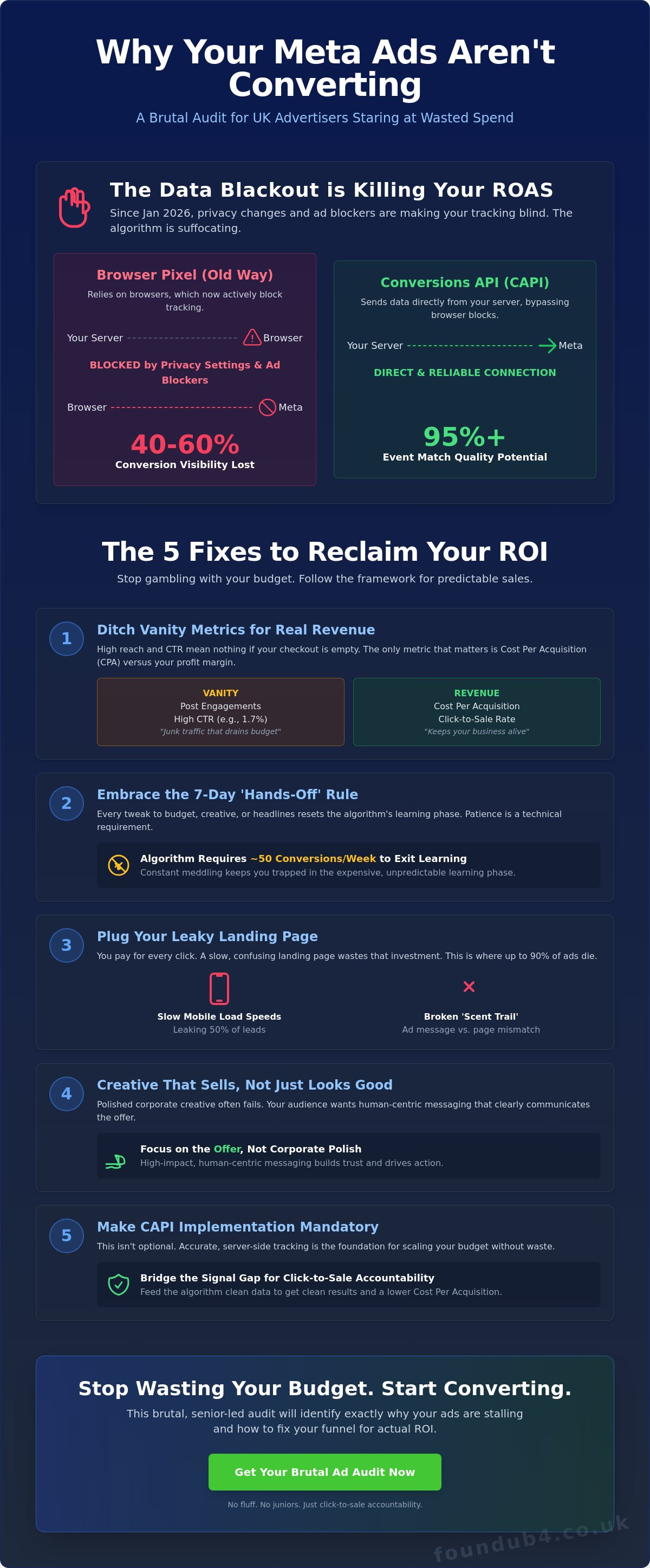
- Bridge the 2026 data gap by implementing the Conversions API (CAPI) to reclaim the 40-60% of conversion visibility lost to browser privacy and ad blockers.
- Fix the primary reason my facebook ads are not converting by ditching polished corporate creative for high-impact, human-centric messaging that focuses on the offer.
- Audit your "scent trail" and mobile load speeds to ensure your landing page converts the traffic you have paid for instead of leaking 50% of your potential leads.
- Master the FoundUB4 growth framework to scale your budget horizontally or vertically without triggering the algorithm's restrictive learning phase trap.
Why Your Facebook Ads Are Not Converting: The Brutal Audit
If you are currently shouting "my facebook ads are not converting" at your screen, you are likely looking at the wrong dashboard. Ads don't fail in a vacuum; they fail because of a broken bridge between the click and the offer. Since the massive attribution update on March 3, 2026, Meta now only counts clicks on a link for click-through attribution. If you are still judging success by post engagements or video views, you are chasing ghosts. High reach is a commodity. Click-to-sale accountability is the only metric that keeps your business alive.
Most advertisers blame the algorithm for poor performance. They claim the "Andromeda" update ruined their targeting. In reality, the algorithm is usually doing exactly what you told it to do. If you feed it poor data or confusing signals, it will deliver poor results. A brutal audit requires you to stop looking for excuses in the Meta Business Suite and start looking at your fundamental strategy. If your cost per 1,000 impressions (CPM) is within the 2026 average of £6.50 to £11.50 but your sales are flat, the problem isn't Meta. It's your offer.
Vanity Metrics vs. Actual Revenue
Stop celebrating a high click-through rate (CTR) if your checkout page is empty. A 1.7% CTR looks great on a spreadsheet, but it is often just "junk" traffic. These are users who click out of curiosity but have zero intent to buy. They inflate your stats whilst draining your bank account. The history and mechanics of online advertising prove that reach is a commodity, but conversion is a craft. You must identify the one metric that actually moves the needle. For most, that is the Cost Per Acquisition (CPA). If your CPA is higher than your profit margin, your campaign is a liability, not an asset.
The 'Stop Meddling' Rule
Patience is a technical requirement, not a virtue. Meta's algorithm requires approximately 50 conversion events per week to exit the learning phase and optimise your delivery. Every time you tweak a headline, change a budget by more than 20%, or swap an image, you reset that clock. This "meddling" is killing your ROAS. I see business owners making daily edits because they are panicked by a 24-hour dip in performance. This is a mistake. You must set a seven-day "hands-off" period. This allows the AI to gather enough data to find your actual buyers amongst the noise. If you can't leave it alone for a week, you aren't trading; you're gambling. Build it. Launch it. Leave it.
The Data Gap: Is Your Meta Pixel and CAPI Actually Firing?
Data is the oxygen of the Andromeda algorithm. If your tracking is broken, the AI is suffocating. Many UK business owners scream "my facebook ads are not converting" whilst their Pixel is only capturing half the story. As of May 2026, relying on a browser-side Pixel alone is a recipe for budget incineration. Browser privacy settings and ad blockers now hide between 40% and 60% of conversion visibility from the standard Pixel. You aren't just losing data. You are teaching the algorithm to find the wrong people.
When Meta lacks visibility, it optimises for the users it can see. These are often "click-happy" users who rarely buy. This creates a feedback loop of junk traffic. You see clicks in the dashboard, but your bank account stays empty. To fix this, you must bridge the signal gap with server-side tracking. This isn't a technical "nice-to-have" anymore. It is the minimum requirement for click-to-sale accountability.
Pixel vs. Conversions API (CAPI)
Server-side tracking is the new industry standard. Browser-based tracking is dying. The Conversions API (CAPI) sends data directly from your server to Meta, bypassing the blocks that stop the Pixel. On January 12, 2026, Meta deprecated 28-day view windows, making accurate click-data even more vital. If your purchase events are missing, your ROAS will look like a disaster even if sales are happening. In April 2026, Meta simplified the process with a one-click CAPI setup, yet many brands still haven't moved. This is the foundation of optimizing Facebook ads for conversions in a privacy-first world. You must ensure you aren't double-counting or missing signals through a botched implementation.
Event Match Quality Scores
Meta assigns an Event Match Quality (EMQ) score to every signal you send. If your score is low, Meta cannot link a website visitor to a specific Facebook profile. This means the AI cannot find your "favourite" buyers because it doesn't actually know who they are. You improve this score by sending more hashed customer data, such as postcodes or email addresses, whilst staying compliant with UK GDPR. Clean data is the fuel for AI-powered bidding. If your data is a mess, your scaling efforts will fail every single time. For brands that need to cut the waste and fix their tracking, a professional Social Media Consultancy audit can pinpoint exactly where your signal is leaking.
Messaging Failure: Creative That Looks Good vs. Creative That Sells
Aesthetics don't pay bills. High-gloss, agency-style creative often wins awards whilst losing money. If you are currently frustrated because my facebook ads are not converting, you are likely prioritising graphic design over direct-response psychology. In the 2026 Andromeda algorithm era, your creative is your targeting. Meta no longer relies solely on the interests you select; it uses the content of your ad to find your buyers. If your messaging is vague, your audience will be too. You don't need a prettier ad. You need a better offer.
The "Anti-Agency" approach is simple: focus on the friction, not the filters. Most ad copy is too corporate and lacks the human touch required to stop a scroll. Users don't go to Facebook to be sold to by a faceless brand. They want solutions to their specific pains. If your ad looks like a polished commercial, users will treat it like one and skip it. Data from May 2026 shows that AI-powered creative is currently outperforming human-only designs by 18% in click-through rates. This isn't about replacing creativity. It is about using smart execution to find what moves the needle.
The Offer-Market Fit Test
You can't fix a bad product with a high ad budget. Before you spend another £1,000, ask if your offer actually provides immediate value. Testing different "angles" is far more effective than changing a button colour or a font. For example, a "Buy One Get One Free" offer might fail whilst a "Free Trial" or a "Performance Guarantee" scales. You must sweeten the deal to lower friction at the first point of contact. If the market doesn't want what you're selling at the price you're asking, no amount of technical wizardry will save your ROAS.
Breaking Through the Scroll
The first 3 seconds of your video determine the fate of your entire campaign. This is the "Hook" phase. You must use a pattern interrupt to stop the thumb. This could be a bold statement, a surprising visual, or a direct question that addresses a specific pain point. Once you have their attention, the "Body" must build desire by showing the transformation your product offers. Finally, the "CTA" must be a single, clear instruction. Don't ask them to "Learn More" if you want them to "Book Now". Clarity beats cleverness every time. If you notice your CTR dropping below the 1.4% industry average, creative fatigue has set in. It's time to kill the ad and launch a new hook. No fluff. No vanity. Just results.
The Landing Page: Where 90% of Facebook Ads Die
You've fixed the tracking. You've sharpened the creative. Yet, the dashboard still says my facebook ads are not converting. The truth is brutal: your landing page is likely a leaky bucket. Most advertisers treat the landing page as an afterthought, sending high-intent traffic to a generic homepage or a bloated "About Us" section. This is where 90% of Meta budgets go to die. You need a "scent trail" that maintains the momentum from the ad to the checkout. If there's a disconnect in messaging, design, or offer, the user bounces. You lose the sale. Meta keeps the cash.
Conversion Rate Optimisation (CRO) isn't just for tech-heavy agencies. It is a fundamental business requirement. If your ad promises a solution to a specific UK market pain point, your landing page must deliver that solution instantly. Every extra click, every confusing headline, and every unnecessary navigation link is an exit point. You are paying for traffic; stop giving that traffic reasons to leave. For brands ready to stop the leak, I provide custom Landing Page Creation services that focus entirely on the bottom line. No fluff. No distractions. Just conversions.
The 5-Second Landing Page Audit
Can a user tell exactly what you offer and how to buy it within five seconds? If not, you've failed. High-converting funnels follow a "One Page, One Goal" philosophy. Eliminate bloated headers and confusing navigation menus that lead users away from the CTA. Your headline should mirror the ad copy that brought them there. If the ad mentioned a specific discount in GBP, that discount should be the first thing they see. Clarity is the only thing that moves the needle at this stage of the funnel.
Mobile Performance and Speed
Designing for desktop is the biggest mistake in Meta advertising. Over 90% of Facebook users access the platform via mobile. If your page looks great on a MacBook but breaks on an iPhone, your ROI is dead. Speed is a non-negotiable metric. A 3-second load time is costing you 50% of your traffic. UK users on 4G or 5G networks won't wait for your high-res images to load. Use tools like Google PageSpeed Insights to test your real-world mobile speed. Simplify your forms. Remove unnecessary fields. Every additional form field can drop lead generation rates by up to 11%. Keep it lean. Keep it fast. Built to convert.
Scaling Without the Waste: The FoundUB4 Growth Framework
Scaling is the final stage of the recovery checklist. If you were recently shouting "my facebook ads are not converting", you only move to this phase once your CPA is stable and your funnel is airtight. Scaling a broken campaign only accelerates your losses. You need a "Green Light" from your data. This means achieving at least 50 conversion events per week at a cost that leaves room for a healthy profit margin. If your metrics are inconsistent, scaling will only lead to more wasted spend. You must be certain that your tracking is firing and your offer is resonating before you pour more fuel on the fire.
Vertical scaling involves increasing the budget on your winning ad sets. However, doing this too aggressively is a technical mistake. A 100% budget hike overnight will reset the learning phase and likely destroy your ROAS. I recommend the 20% rule: increase your budget by no more than 20% every 48 to 72 hours. This keeps the algorithm stable whilst you grow. Alternatively, horizontal scaling allows you to test new "winning" creative or broader audiences to find new pockets of buyers. This moves the needle without risking the performance of your core campaigns. It's about finding the balance between stability and growth.
The Rules of Scaling
Protecting your margins is paramount during expansion. In 2026, I use "Cost Caps" to ensure Meta doesn't spend your budget on expensive, low-intent traffic. This acts as a safety net for your bank account. You must also identify your winning creative before you increase spend. Look for ads with a CTR above the 1.4% industry average and a high "thumb-stop" rate in the first 3 seconds. These are the assets that deserve the most spend. Don't waste money on mediocre creative that barely breaks even. Scale the winners; kill the laggards.
Built to Convert, Built to Scale
Most agencies will pass you to a junior account manager the moment you sign a retainer. FoundUB4 is different. I am a senior-led consultant, not an agency posing as one. I provide click-to-sale accountability and a growth framework built on two decades of battle-hardened experience. I cut the fluff, remove the layers of "corporate-speak", and focus entirely on your bottom line. You don't need a bloated agency to manage your growth; you need smart execution. It's time to stop wasting ad spend and book your growth call with FoundUB4 today. No juniors. No vanity metrics. Just predictable ROI. Built to convert. Built to scale. Built by me.
Stop Burning Cash and Start Scaling
Fixing your ROI requires moving beyond vanity metrics and embracing click-to-sale accountability. You've learned that a 3-second mobile load time is a non-negotiable requirement for UK users. You've also seen why the 2026 Andromeda algorithm demands high-quality data through CAPI to find your buyers. If you've been frustrated because my facebook ads are not converting, the solution lies in the bridge between your creative hook and your landing page offer. Stop meddling with daily edits and let the data guide your growth.
You don't need a bloated agency with layers of junior staff to manage your spend. You need a battle-hardened expert with over 20 years of industry experience. I provide senior-led execution that cuts the fluff and focuses entirely on your bottom line. It's time to stop gambling with your budget and start building a predictable sales engine. Your business deserves a partner who values results over impressions. Scale your Meta ads with a no-nonsense growth strategist today and turn your stalled campaigns into a high-performance funnel. You have the checklist. Now it's time to execute.
Frequently Asked Questions
How long should I wait before deciding an ad isn't converting?
You must wait at least seven days before making any major changes. Meta's algorithm requires approximately 50 conversion events per week to exit the learning phase and stabilise your delivery. If you kill an ad after 48 hours because of a temporary dip, you are preventing the AI from finding your buyers. Patience is a technical requirement for click-to-sale accountability. Build it, launch it, and leave it alone for a full week.
Why is my CTR high but my conversion rate low?
A high CTR with a low conversion rate usually means you are buying "junk" traffic or your landing page is leaking leads. Your ad is doing its job by stopping the scroll, but your offer or website is failing to close the deal. If you notice this gap, audit your "scent trail" to ensure the messaging on your page matches the ad perfectly. High clicks mean nothing if your checkout page stays empty.
Is my Facebook ad budget too small to see results?
Your budget is too small if it cannot support 50 conversions per week at your target CPA. For example, if your target CPA is £20, a daily budget of £5 won't provide enough data for the algorithm to optimise. You don't need thousands to start, but you must spend enough to feed the AI. If your budget is tight, focus on a single high-impact campaign rather than spreading £10 across five different ad sets.
What is the 'Learning Phase' and why does it matter?
The learning phase is the period where Meta's system explores the best way to deliver your ad set. During this time, performance is often unstable and your CPA may fluctuate. It matters because every "significant edit" you make resets this phase. If you are constantly meddling with your ads, you'll never achieve predictable sales. Stop the "tweak-and-peek" behaviour and let the system gather enough data to move the needle.
Should I use 'Advantage+' campaigns or manual targeting?
Use Advantage+ Shopping campaigns if you are in eCommerce, as 2026 data shows they deliver a 32% lower CPA than manual setups. For service-based businesses or niche B2B, manual targeting still has its place for strict control. However, the Andromeda algorithm increasingly favours broad targeting. It uses your ad creative to find the audience. Trust the AI for scale, but use manual controls if you need to stay within very specific UK postcodes.
How do I know if my Meta Pixel is actually working?
Check your Events Manager for the Event Match Quality (EMQ) score. If your score is below 6.0, your signal is leaking and Meta is struggling to link visitors to profiles. You should also verify that your Conversions API (CAPI) is firing alongside your Pixel. As of May 2026, a "Pixel only" setup is broken. If you don't see green "Active" status lights next to your purchase events, your tracking is failing your business.
Does the '20% text rule' still exist for Facebook ad images?
The formal 20% text rule was scrapped years ago, but heavy text still penalises your reach. Meta's system still prefers images with minimal text, often rewarding them with lower CPMs. If your ad looks like a cluttered flyer, users will scroll past it. Focus on a high-impact visual and a punchy headline in the primary text area instead. Let the copy do the heavy lifting whilst the image stops the thumb.
Why are my Facebook ads getting clicks but no sales?
This is the most common reason business owners say my facebook ads are not converting. It is almost always a disconnect between the ad's promise and the landing page's reality. If your ad promises a "50% off UK summer sale" but the link lands on a generic homepage, the user will bounce. You have paid for the click; don't waste it with a confusing user journey. Fix the friction on your site and your sales will follow.
